
41 Clayton St. #300, Asheville, NC 28801



The contact buttons don’t always work on every device. If they are not working for you, here is how to contact us and schedule your appointment.
41 Clayton St. #300, Asheville, NC 28801
“History has shown us that courage can be contagious, and hope can take on a life of its own. ”
~ Michelle Obama
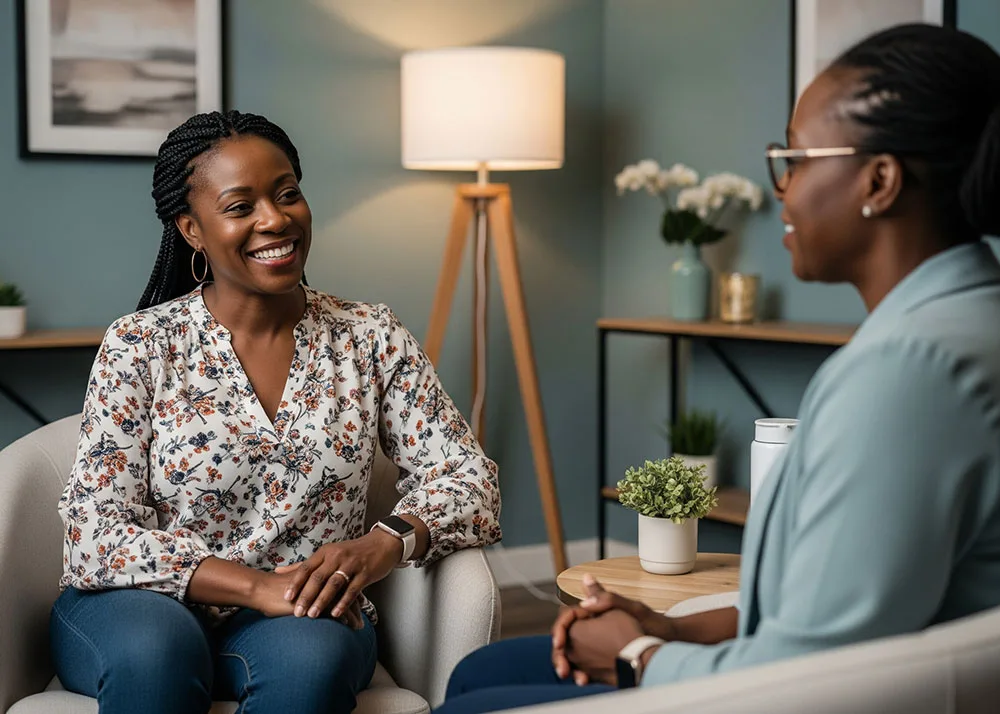
Are you tired of feeling like you have to be the strong one all the time? Do you feel unseen, unheard, or misunderstood? As a Black woman in today’s world, you face a unique set of challenges.
From microaggressions to systemic racism, the weight of the world can feel heavy. But you don’t have to carry it alone. Therapy for Black women can provide a safe space to heal, grow, and reclaim your power.
At Resilient Mind Counseling, we see you, we hear you, and we believe you. We are an anti-racist practice dedicated to providing affirming and effective therapy for Black women throughout North Carolina.

“My mission in life is not merely to survive, but to thrive; and to do so with some passion, some compassion, some humor, and some style.”
– Dr. Maya Angelou
There has never been a more crucial time to place your healing at the forefront of your life. As a Black woman, you constantly navigate a world that demands your strength, but therapy provides a dedicated sanctuary to finally set that weight down. This is your chance to move beyond the expectation of being endlessly resilient and to actively cultivate your own peace and well-being.
Prioritizing therapy now is a powerful declaration that your mental health is not a luxury, but an essential part of a joyful and sustainable future you deserve to experience today.
Your experiences are valid. The constant pressure to be resilient, the emotional labor of navigating predominantly white spaces, the intergenerational trauma – it all takes a toll. Therapy for Black women is not a luxury; it’s a vital tool for self-preservation and empowerment.
Here’s how therapy for Black women can help you:

At Resilient Mind Counseling, we believe that you are the expert on your own life. Our therapists, many of whom are part of the BIPOC community, are here to walk alongside you on your journey of healing and self-discovery. We offer a warm, non-judgmental, and culturally sensitive approach to therapy for Black women.
We specialize in:
We also offer specialized therapy for neurodivergent individuals and members of the LGBTQIA+ community.

Taking the first step is often the hardest, but you don’t have to do it alone. If you’re ready to start your journey of healing and empowerment, we invite you to schedule a free consultation with one of our compassionate therapists.
Start by following these steps:
STEP-01
Start by reaching out to us for a free consultation.
BOOK NOW

STEP-02
Then you can schedule your first appointment with one of our online therapists.
Choose Therapist
STEP-03
Get the support and understanding you need and deserve!
Start Now
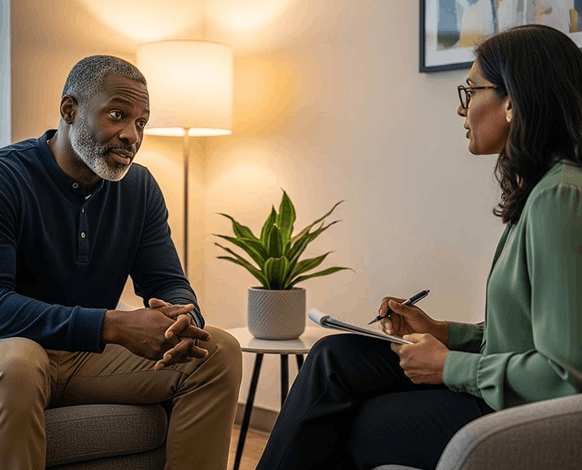
At Resilient Mind Counseling, we believe in providing inclusive counseling services. This is why we also provide supportive therapy for those who identify as Neurodivergent and LGBTQ. Our online therapists in North Carolina also provide anxiety treatment, depression treatment, and PTSD treatment. As well as mood disorder treatment, marriage counseling, and couples therapy.
For accessibility, we provide these services through online therapy in North Carolina.
We accept payment through a HIPAA compliant payment processing software.
This ensures that your financial information remains encrypted and protected.
Therapy can be vulnerable and new, so it’s natural to be nervous. It can be scary to think of opening up or crying in front of someone new, perhaps fearing that it will be awkward and uncomfortable. The fear around that can feel overwhelming. Getting the counseling we need can be challenging. And although it’s normal to be nervous, that doesn’t make it feel great. It takes courage to continue getting the help you need.
Therapy is a space where you can be yourself and feel safe from judgment, including feeling nervous. We’re committed to finding a way to care for your nervousness and ensure sessions are as comfortable as possible.
We’re here if you want to talk about it during a free phone consultation.
Take your time to read through this website. If you sense that we may be a good fit based on what you are reading, you can call us.
During a free phone consultation, you can ask one of our therapists about how they have helped other people like you before, ask how they work as a therapist, or any other questions you may have that are specific-to-you. You’ll also be able to tell them what’s up, and you and one of our therapists can decide together how they can help.
It will usually take a couple of sessions to feel comfortable and develop a relationship. During the sessions, you’ll be able to understand how comfortable you feel in sessions. Our approach is not going to work for everyone. What’s most important is that you find someone who you feel is the right fit for you. We can explore that together.
If something feels overwhelming or even terrifying to discuss, that’s actually very normal. It can often feel difficult to talk about some things. During sessions, your therapist will never push you to talk about things that are too painful for you to talk about. They will be there to guide you towards discovering what feels comfortable for you to share. Working at your pace, together you can look at the tough stuff if you’re ready.
You can also share with them that you are nervous to open up about something, and you and your therapist can talk about that too. Whatever is present for you. Whatever you are going through. Bring that to session and you can explore that together.
If you open up, we will not think you are crazy. We will think you are someone who’s very courageous. Many clients have had the same fear (that people would think they are crazy).
Through our own life journeys and working with clients, we know how “normal” your experience is.
You’re not being dramatic or “too much.” Nothing you can say will cause us to judge you.
We know nobody’s perfect. We all struggle. We all suffer in different ways.
Whatever it is you’re going through, we provide a safe space where you can feel heard and supported without judgment.
You might already know that you want to share sensitive information about your loved ones and you don’t want them to find out what you’ve said. So we want you to know that unless there is an imminent danger to yourself or someone else, everything you share is completely confidential.
There is nothing more important than your privacy.
You can rest assured that you can talk about anything without fear of that information getting out.
If you have specific questions about how confidentiality works, you can ask during your free phone consultation or anytime during your work with your therapist.
Overall, you can think of the first session as a structured assessment that helps your therapist get to know you and the challenges that brought you into treatment. They’ll invite you to share more about yourself, and you can also talk about what’s worked or not worked for your mental health in the past.
Some questions that your therapist might ask during a first session include:
You can ask your therapist questions as well. You might be curious about their experience or how future sessions work.
The most important part of a first session is that you see if you feel your therapist is a good fit for you. If you feel supported, seen, and at ease with them, you can discuss if you’d like to meet again.
Sometimes the hardest part is getting started. We’re here to make it easier with a free consultation—just a conversation, no pressure, only support.